
TechnologyDrop-Tech develops droplet-on-demand technology and associated microfluidic devices for diagnostic applications and drug screening.
|
Droplets-on-demand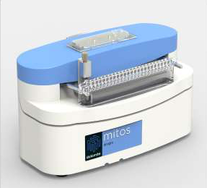
|
Merging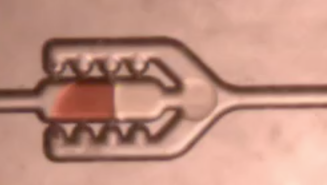
Merging pairs of droplets generate dilution gradients and combinatorial libraries of compounds.
|
Dilution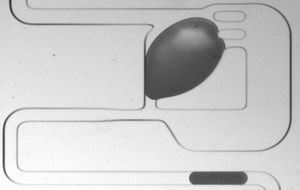
Dilution gradients can also be created from a mother droplet and series of smaller diluent droplets.
|
Applications
The Dropix allows users to generate sequences of droplets to use directly into a variety of microfluidic applications.
You can download the Dropix Application Note to find out more.
You can download the Dropix Application Note to find out more.
- Small molecule screening
- Kinetic assays
- Crystallography for precious protein samples
- Droplet Spliting
- Cell-based assays include single-cell studies
- Forensics
Publications
A Fully Unsupervised Compartment-on-Demand Platform for Precise Nanoliter Assays of Time-Dependent Steady-State Enzyme Kinetics and Inhibition

Abstract: The ability to miniaturize biochemical assays in water-in-oil emulsion droplets allows a massive scale-down of reaction volumes, so that high-throughput experimentation can be performed more economically and more efficiently. Generating such droplets in compartment-on-demand (COD) platforms is the basis for rapid, automated screening of chemical and biological libraries with minimal volume consumption. Herein, we describe the implementation of such a COD platform to perform high precision nanoliter assays.
The coupling of a COD platform to a droplet absorbance detection set-up results in a fully automated analytical system. Michaelis–Menten parameters of 4-nitrophenyl glucopyranoside hydrolysis by sweet almond β-glucosidase can be generated based on 24 time-courses taken at different substrate concentrations with a total volume consumption of only 1.4 μL. Importantly, kinetic parameters can be derived in a fully unsupervised manner within 20 min: droplet production (5 min), initial reading of the droplet sequence (5 min), and droplet fusion to initiate the reaction and read-out over time (10 min). Similarly, the inhibition of the enzymatic reaction by conduritol B epoxide and 1-deoxynojirimycin was measured, and Ki values were determined. In both cases, the kinetic parameters obtained in droplets were identical within error to values obtained in titer plates, despite a >104-fold volume reduction, from micro- to nanoliters.
You can find our publication on the Analytical Chemistry website.
The coupling of a COD platform to a droplet absorbance detection set-up results in a fully automated analytical system. Michaelis–Menten parameters of 4-nitrophenyl glucopyranoside hydrolysis by sweet almond β-glucosidase can be generated based on 24 time-courses taken at different substrate concentrations with a total volume consumption of only 1.4 μL. Importantly, kinetic parameters can be derived in a fully unsupervised manner within 20 min: droplet production (5 min), initial reading of the droplet sequence (5 min), and droplet fusion to initiate the reaction and read-out over time (10 min). Similarly, the inhibition of the enzymatic reaction by conduritol B epoxide and 1-deoxynojirimycin was measured, and Ki values were determined. In both cases, the kinetic parameters obtained in droplets were identical within error to values obtained in titer plates, despite a >104-fold volume reduction, from micro- to nanoliters.
You can find our publication on the Analytical Chemistry website.
A microdroplet dilutor for high-throughput screening

Abstract: Pipetting and dilution are universal processes used in chemical and biological laboratories to assay and experiment. In microfluidics such operations are equally in demand, but difficult to implement. Recently, droplet-based microfluidics has emerged as an exciting new platform for high-throughput experimentation. However, it is challenging to vary the concentration of droplets rapidly and controllably. To this end, we developed a dilution module for high-throughput screening using droplet-based microfluidics. Briefly, a nanolitre-sized sample droplet of defined concentration is trapped within a microfluidic chamber. Through a process of droplet merging, mixing and re-splitting, this droplet is combined with a series of smaller buffer droplets to generate a sequence of output droplets that define a digital concentration gradient. Importantly, the formed droplets can be merged with other reagent droplets to enable rapid chemical and biological screens. As a proof of concept, we used the dilutor to perform a high-throughput homogeneous DNA-binding assay using only nanolitres of sample.
You can find our publication on the Nature Chemistry website.
You can find our publication on the Nature Chemistry website.